
Getting ITO list without void objects?
-
I have been thinking if there is any solution or workaround regarding this matter.
https://imgur.com/RHjRnAFIs it possible to get a list of diameters of where an collision has been made with my light wall without voids? I have a house filled with pipes and ducts that are going through all the light walls and I would like to know how many that has been crossing the wall and also their diameter.
Thanks in advance!

-
You mean you don’t have voids or openings and you want an ITO of what basically is the outcome of an intersection check between MEP and Walls?
I guess not, the easiest would be to create those openings (probably even automatically with a Script or CAD Software) and you generate Provisions for Voids which then can be of course be used for an ITO.
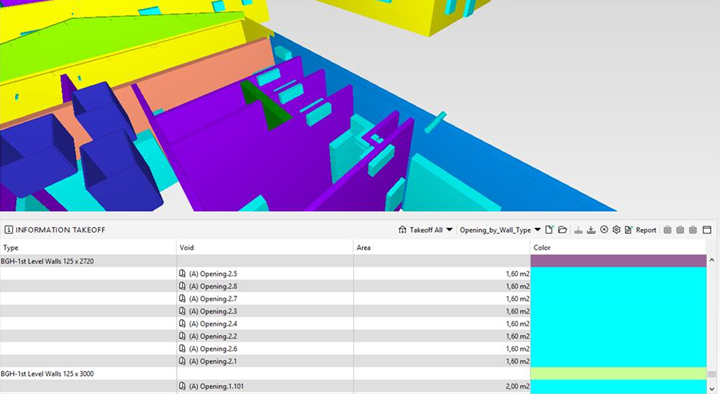
-
That is correct, it doesnt have to necessary be an ITO list as long as its easy to get a quantification on their diameter and how many it is
Yeah I was thinking of that as well but it seems impossible as I do only have an IFC

I have something called “bounding box height” and I was thinking like this:
Do a general intersection test between disciplin and wall
filter all for example “1000mm” in bounding box height as well as width.
That is the only approach that I could think of. -
@Jimin said in Getting ITO list without void objects?:
Yeah I was thinking of that as well but it seems impossible as I do only have an IFC
Why impossible? Depending on what software you use it could indeed be possible. It might not be a beautiful workflow due to the known circumstances, but I would not say there is no way at all.
Example: You could import your walls and the colliding MEP Elements in Archicad and then use the Opening Tool to let the openings be created. That should work, although it would be a much better result with dedicated Provision for Void collision elements - but of course you don’t have them because otherwise we would not discuss this here. Well, anyhow, this step would provide you with those provisions (the IfcOpenings) and the dimensions you are looking for. I could also think of the one or the other alternative method how you could achieve what you want but this is probably by far the easiest.
Regarding the intersection check I would say that it would work if you have for example just this one rule and you make your specifications clear enough. However, I guess it still requires lots of manual work.
Anyhow, which way you go in the end it should depend a bit on how complex the project is, how often you have to apply the method and how much time you could save compared to traditional workflows. Good luck.

Copyright © 2025 Solibri Inc. | Powered by NodeBB