
Building Life Cycle and carbon emissions
-
Hello Society users!
And a happy new year to all of you!
To start off the year, we would like some insights on the topic of building life cycle and carbon emissions. We want to reach out and ask, how important is this in your workflows? Is there a certain way you use (or could use) Solibri for these assessments and calculations? Are you integrating with another platform, and if so, what are you using to make these calculations?
Kind regards,
Toni on behalf of the Solibri team
-
Hello,
I’d like to refresh this topic a little bit.

It becomes more and more important to integrate LCA into our workflows and we started some tests with Solibri.
-
We gather IFC from Archicad and explode all composite elements in IfcBuildingElementPart to get all the volumes by material (except doors and windows that don’t have material yet).
-
We integrate a LCA database as a classifications (many).
-
We link (via classification) the IfcMaterial to the LCA database entry with some rules.
-
We link these entries to the reference unit (kg, m3, m2, pcs, etc), the density and the carbon impact factor.
-
We then make an ITO with all the columns needed to make a calculation (volume x density x carbon factor = carbon impact).
This calculation could be made in Solibri or Excel but it would be simpler in Solibri (we will use the Javascript column for now).
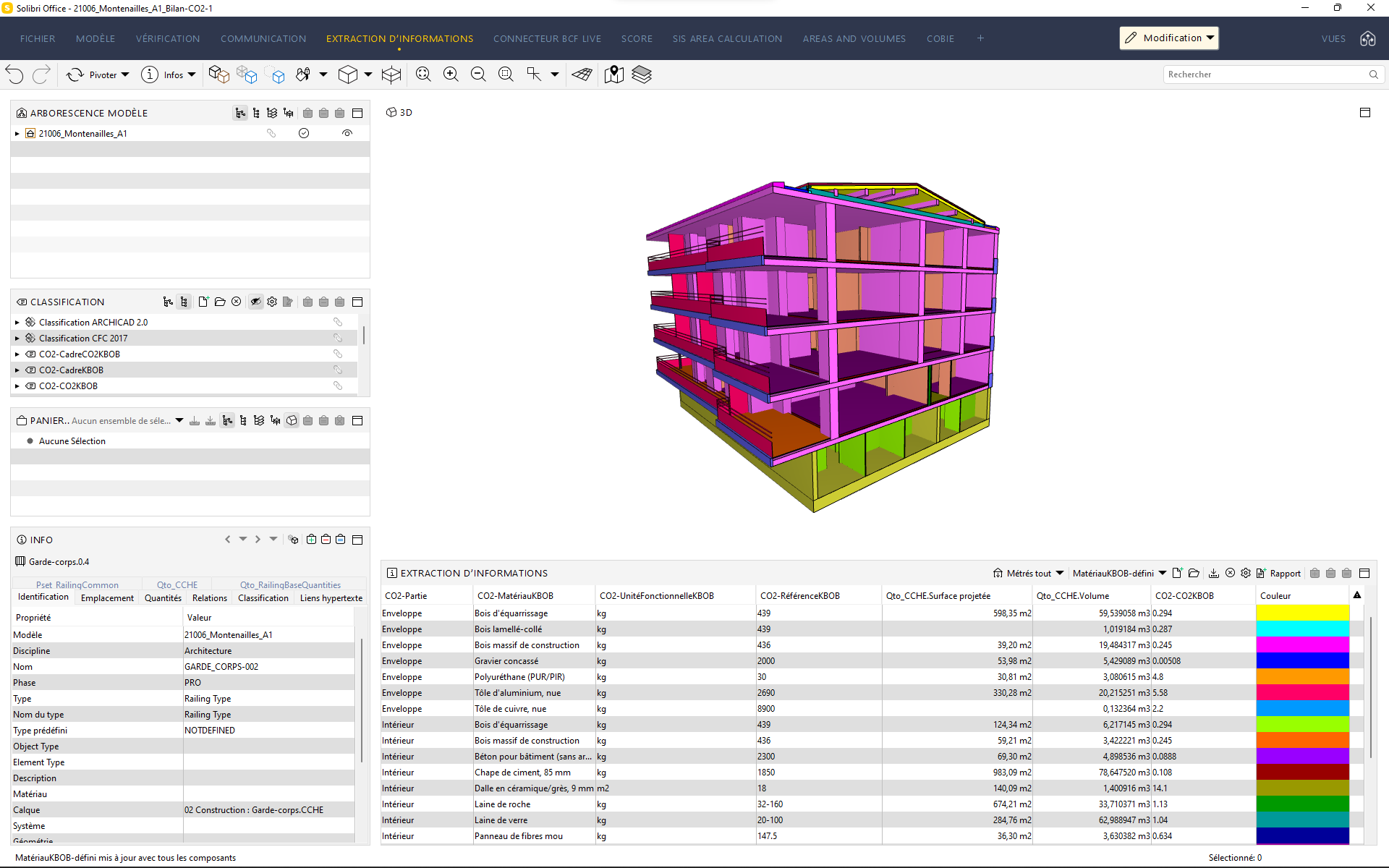
Where we struggle is for elements that don’t have a one to one relationship.
We have doors and windows that are constituted of a frame and a glazing.
Or spaces that host all the information about the HVAC (the database gives information by m2 of constructed area).We can’t figure out how to get the right impact factors since the classification can’t understand arrays of data for the classification rules.
So right now we are stuck and looking into other solutions / possibilities.
And this only the first part because we still need to present the data to put it in relation with objectives (x kgCO2eq per m2) and to be able to make some tweaks to the model to reach the objective (change windows framing per example).
And how to manage what is not modelled?
Hope this gives you ideas on how to tackle this topic

And please if you have any ideas, it would be greatly appreciated!
All the best!PS : Images don’t upload, I’ll try it later!
-
-
@mathieu-farine said in Building Life Cycle and carbon emissions:
Where we struggle is for elements that don’t have a one to one relationship.
We have doors and windows that are constituted of a frame and a glazing.
Or spaces that host all the information about the HVAC (the database gives information by m2 of constructed area).We can’t figure out how to get the right impact factors since the classification can’t understand arrays of data for the classification rules.
I have this topic also on my desk, and in general I would say that the need for solutions here are on the raise. There are a solution approaches and regarding informatiobn on building elements using material properties and building element part quantities did produce some good results - at least to a certain point. The quality of the input data definitely matters here. Although I think due to the complexity there won’t be a single ITO solution, especially not when it comes to HVAC. And yes currently there are some limitations when it comes to quantities, but this is more a data schema issue in general and less the problem of Solibri’s shortcomings on performing maths - although any improvements would be warmly welcomed here as well.
-
Super important already and will be even more so. We do the co2 quantities in Archicad directly, not the smoothest way and hard to compare and test alternatives.



Copyright © 2025 Solibri Inc. | Powered by NodeBB