Skip to content
  • Categories
Collapse
Solibri Society Forum
  1. Home
  2. Comments & Feedback
  3. Tech Talks
  4. Extracting elements (including quantities) by spaces / zones

Extracting elements (including quantities) by spaces / zones

Scheduled Pinned Locked Moved Tech Talks
8 Posts 3 Posters 1.9k Views
  • Oldest to Newest
  • Newest to Oldest
  • Most Votes
Log in to reply
This topic has been deleted. Only users with topic management privileges can see it.
  • JeroenKoomenJ Offline
    JeroenKoomenJ Offline
    JeroenKoomen
    wrote on last edited by
    #1

    Hi there,

    I am looking for the best way to extract elements (including their quantities) by their relationship to a space or zone.

    The problem is that in my models there is a wide variety of differrent spaces (rooms / area’s of appartments / gross areas etc.).

    So the option “nearest spaces” does not give reilable results.

    The goal is to get an ITO of elements and there quantities per space, but only specific spaces (only the area’s of appartments).
    Is this possible?
    Is there a solution in the use of spacegrouping?
    Is it possible to exclude some type of spaces when using “nearest spaces” relationship.

    Thanks in advance!

    Jeroen

    http://www.linkedin.com/in/koomenjeroen
    https://www.bimloket.nl/BIMbasisILS

    1 Reply Last reply
    1
    • JeroenKoomenJ Offline
      JeroenKoomenJ Offline
      JeroenKoomen
      wrote on last edited by
      #2

      @Solibrians do you have a any ides?

      http://www.linkedin.com/in/koomenjeroen
      https://www.bimloket.nl/BIMbasisILS

      1 Reply Last reply
      0
      • MattiM Offline
        MattiM Offline
        Matti Solibrians
        wrote on last edited by
        #3

        The nearest spaces relation can be viewed and edited manually in custom relations view.
        The automatic nearest spaces relation is only done for normal spaces . Not for the space groups.
        Space grouping can be affected by modifying the Space Grouping classification.

        Because of this I would recommend following:

        Make sure that the space grouping looks OK. At least you need the apartments and the rooms there.
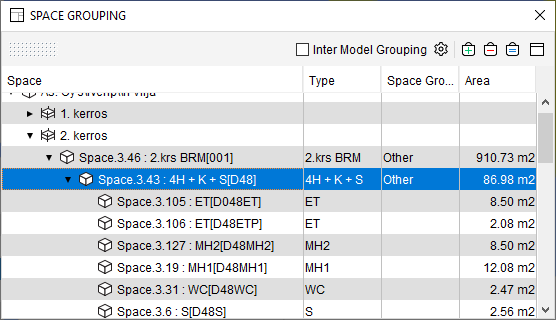
        375a6240-35a4-408e-82a0-8e6f931ef16d-image.png

        I would do it by listing the apartment spaces that are relevant for your ITO. I’m listing 1 or 2 room apartments only.
        List one component per row.
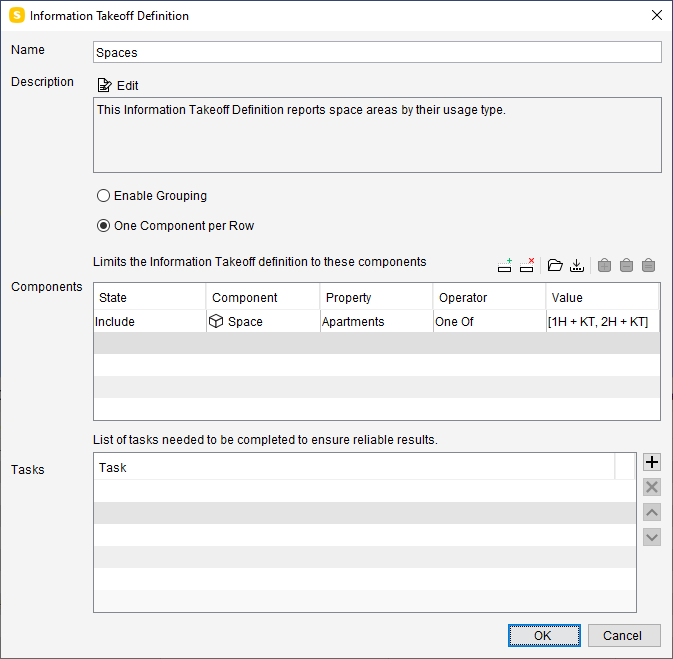
        573986ff-b857-4a06-b020-6d225733fc6a-image.png

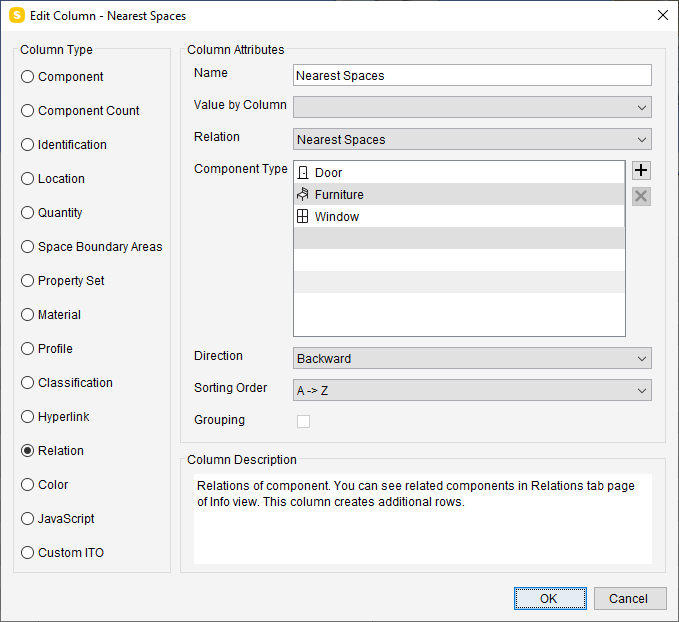
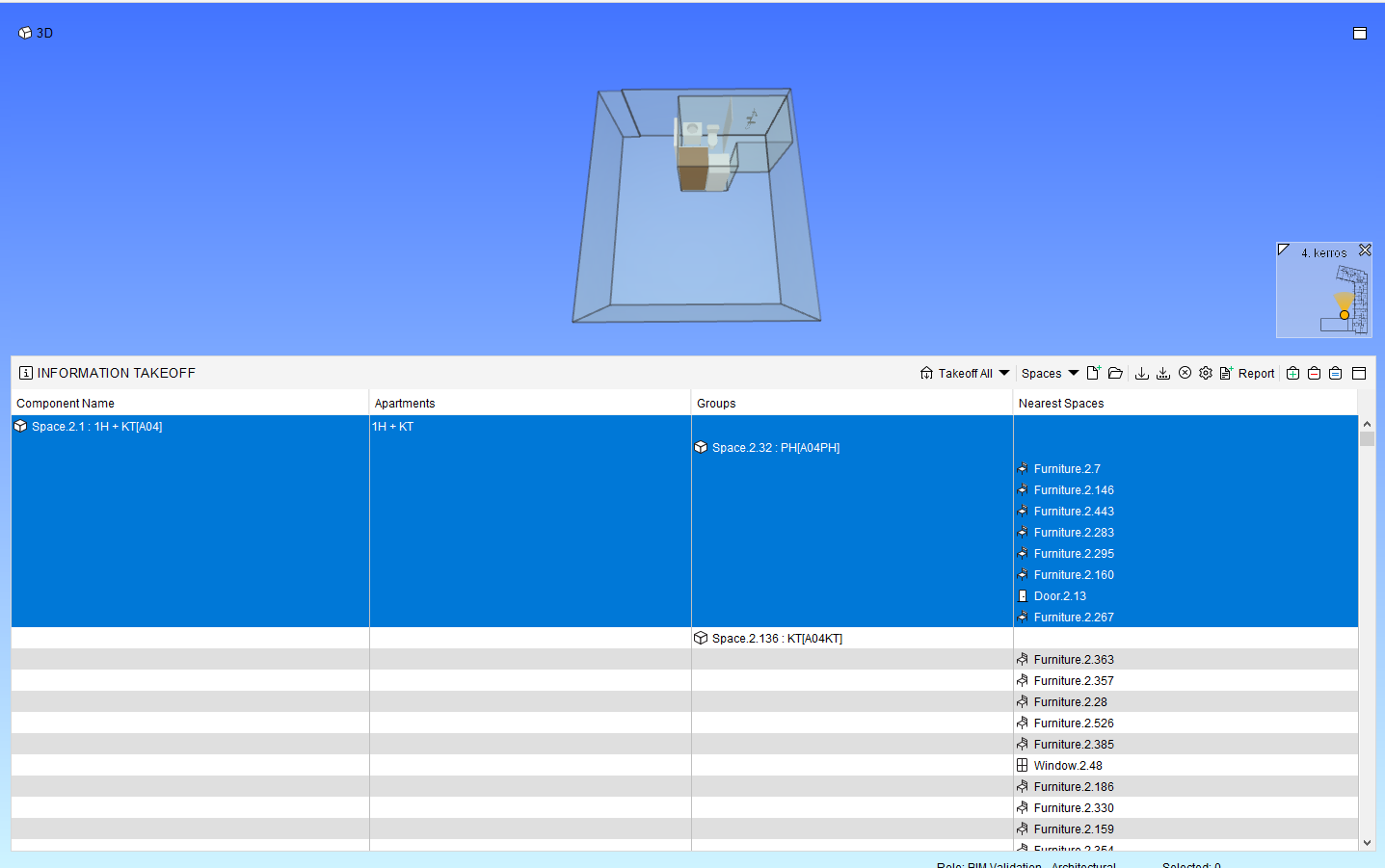
        Then add following ITO columns to have nice hierarchical listing for apartments, their rooms and furniture:
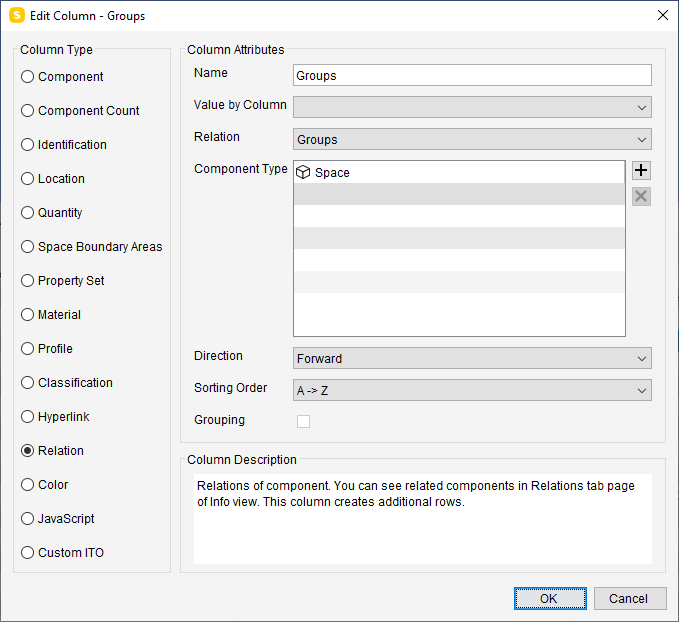
        d854e5c9-5f8c-4513-8ca4-86854cbd1612-image.png
        9d467bb8-c165-4a9e-b1ed-e6e0d0218fea-image.png
        b29190df-7c87-4e6e-b40d-e3c4b33c77f4-image.png

        1 Reply Last reply
        0
        • JeroenKoomenJ Offline
          JeroenKoomenJ Offline
          JeroenKoomen
          wrote on last edited by JeroenKoomen
          #4

          Hi @Matti-Kannala

          Thanks for your reply.

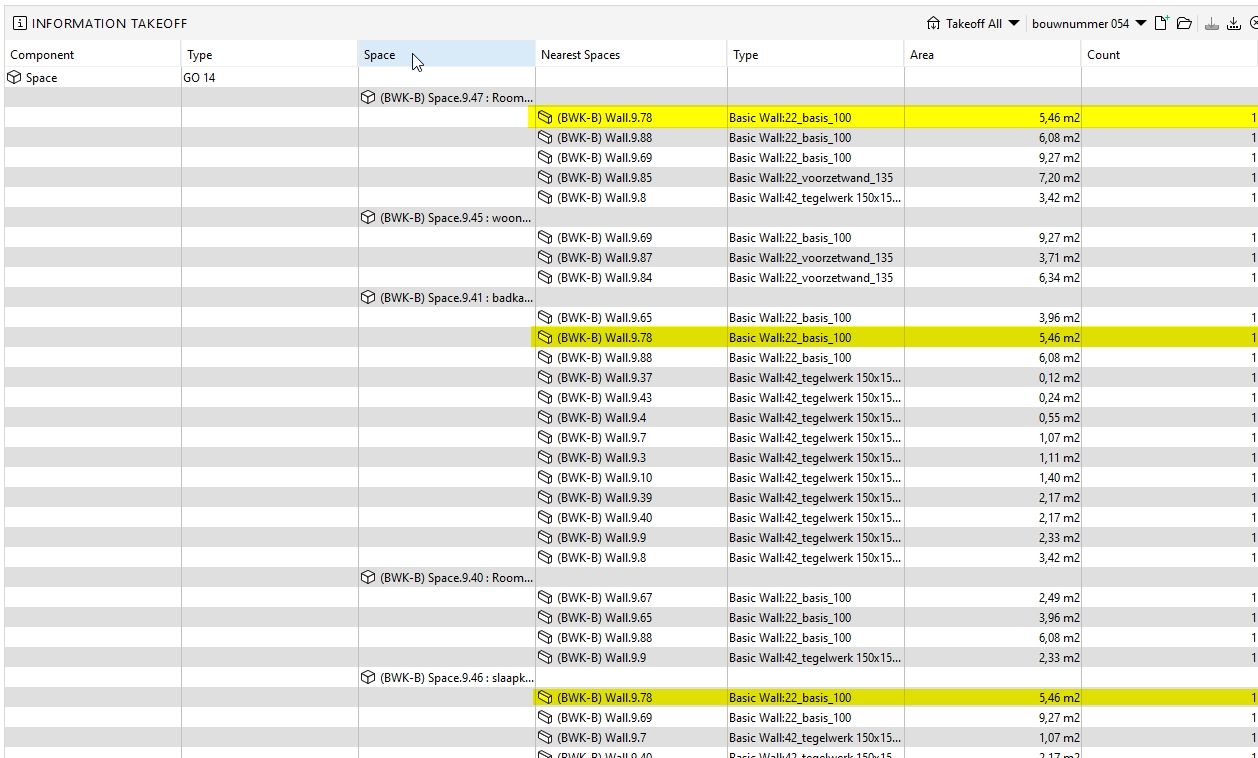
          This works for element in that space, but not for walls between spaces but within that appartment.

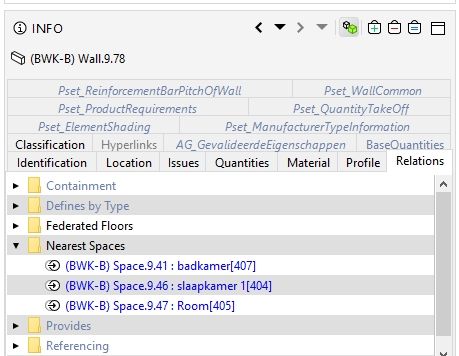
          These walls have 2/3 nearest spaces and show up in my ITO more than once…

          See picture below with the same wall showing up 3 times.

          Is there a way to avoid that?
          2020-03-23 15_56_38-Solibri Office - Test_Jeroen.jpg

          2020-03-23 16_00_55-Solibri Office - Test_Jeroen.jpg

          http://www.linkedin.com/in/koomenjeroen
          https://www.bimloket.nl/BIMbasisILS

          MattiM 1 Reply Last reply
          0
          • MattiM Offline
            MattiM Offline
            Matti Solibrians
            replied to JeroenKoomen on last edited by
            #5

            @JeroenKoomen

            This depends on the modeling. If the walls are long and are near multiple spaces the walls are repeated even more than three times…

            If your model has space boundaries that are correctly defined you can use them for calculating wall areas.
            This post might give some ideas:
            https://society.solibri.com/topic/539/how-to-do-a-information-takeoff-of-the-areas-from-space-boundaries-pset-of-spaces

            E 1 Reply Last reply
            0
            • E Offline
              E Offline
              ERuifrok
              replied to Matti on last edited by
              #6

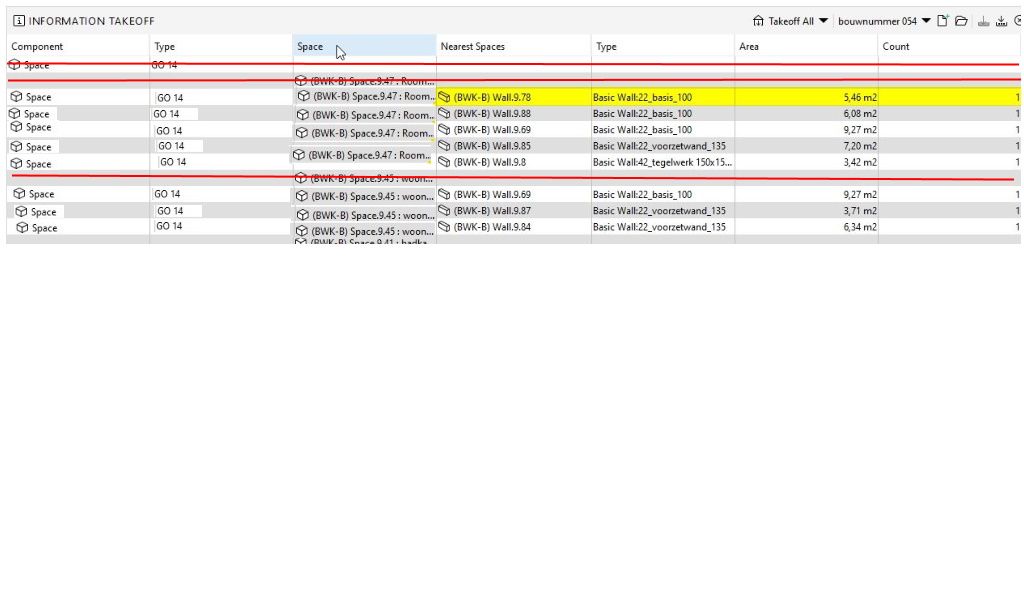
              @Matti-Kannala I’ve got a follow-up question on the above. Is there a way to change the format of these relational take off schedules?. I’d like to import the relational take-offs in other software but the format of the relational take-offs make it hard to import in other platforms it needs a lot of rework. For a human this is easy to read but machines don’t really like it. In the example of Jeroen I would like to have the Component, Type and Space value set in front of each Wall. The first 2 rows which only show the Component Type and Space value can be removed. Is this possible?.

              MattiM 1 Reply Last reply
              0
              • MattiM Offline
                MattiM Offline
                Matti Solibrians
                replied to ERuifrok on last edited by
                #7

                @ERuifrok said in Extracting elements (including quantities) by spaces / zones:

                he example of Jeroen I would like to have the Component, Type and Spac

                Could you sketch a picture of the report how it should look. In the report template you don’t need to have all columns (some columns can be dropped out).

                E 1 Reply Last reply
                0
                • E Offline
                  E Offline
                  ERuifrok
                  replied to Matti on last edited by
                  #8

                  @Matti-Kannala See attached

                  schedule layout.jpg

                  1 Reply Last reply
                  3

                  Copyright © 2025 Solibri Inc. | Powered by NodeBB

                  • Login

                  • Don't have an account? Register

                  • Login or register to search.
                  • First post
                    Last post
                  0
                  • Categories